



Sometime in mid-2025, a lot of people discovered the phrase real estate token.
Worldwide Google searches for it went from almost nothing to a spike in a matter of weeks, then settled into a plateau that held for about a year. Searches for "tokenized real estate", "real estate tokenization" and "fractional real estate" followed the same arc. For a few quarters, owning a slice of a rental house through a token on a blockchain was a thing people were curious about.
That curiosity is fading. Search interest for "real estate token" is now down by about two-thirds from where it sat for most of the past year.
So the boom is over, right?
Not if you look at what investors actually hold.
What the searches say
Here is the uncomfortable part first. By early October 2026, every tokenization search term we checked had dropped back from its 2026 level, and in the United States the decline was steep.
Two things keep this from being the whole story.
First, the drop is not unique to tokenization. In the US, searches for plain "real estate investing" — a term searched dozens of times more often — fell by roughly half over the same weeks. Some of what looks like fading interest in tokens is fading interest in property, or people asking an AI assistant instead of typing into a search box. Search counts can't tell those apart.
Second, the interest that remains is not where you might expect. Ranked by share of local searches, "tokenized real estate" is most popular in Austria, Japan, Germany, Chile and Switzerland, and in Spain "real estate tokenization" takes an unusually large share of these searches. (One ranking puts Iraq first and Saint Helena — population around 4,400 — third, which tells you how thin these numbers get at the edges. Treat the long tail as noise.)
The US built the first wave of this market. The curiosity now lives in Europe and Latin America.
What investors actually hold
We track 1,010 tokenized properties across four retail platforms — RealT, Lofty, Reental and Binaryx — and count who holds each token from on-chain transfer records. That is not a survey or a signup count. A wallet either holds a token or it doesn't.
Start with the headline number and it looks flat: holder positions across all four platforms grew just 4.1% in the twelve months to September 2026.
But one platform is nine-tenths of that number. RealT, which suspended rental distributions in February 2026 and announced a voluntary liquidation in July, holds about 399,000 of the 441,000 positions. Its investor base hasn't grown in a year, for obvious reasons. Take it out, and the picture flips:
| Sep 2025 | Sep 2026 | 12 months | |
|---|---|---|---|
| Reental | 12,621 | 19,131 | +51.6% |
| Lofty | 12,261 | 14,924 | +21.7% |
| Binaryx | 6,691 | 7,990 | +19.4% |
| Three platforms combined | 31,573 | 42,045 | +33.2% |
| RealT | 391,807 | 398,621 | +1.7% |
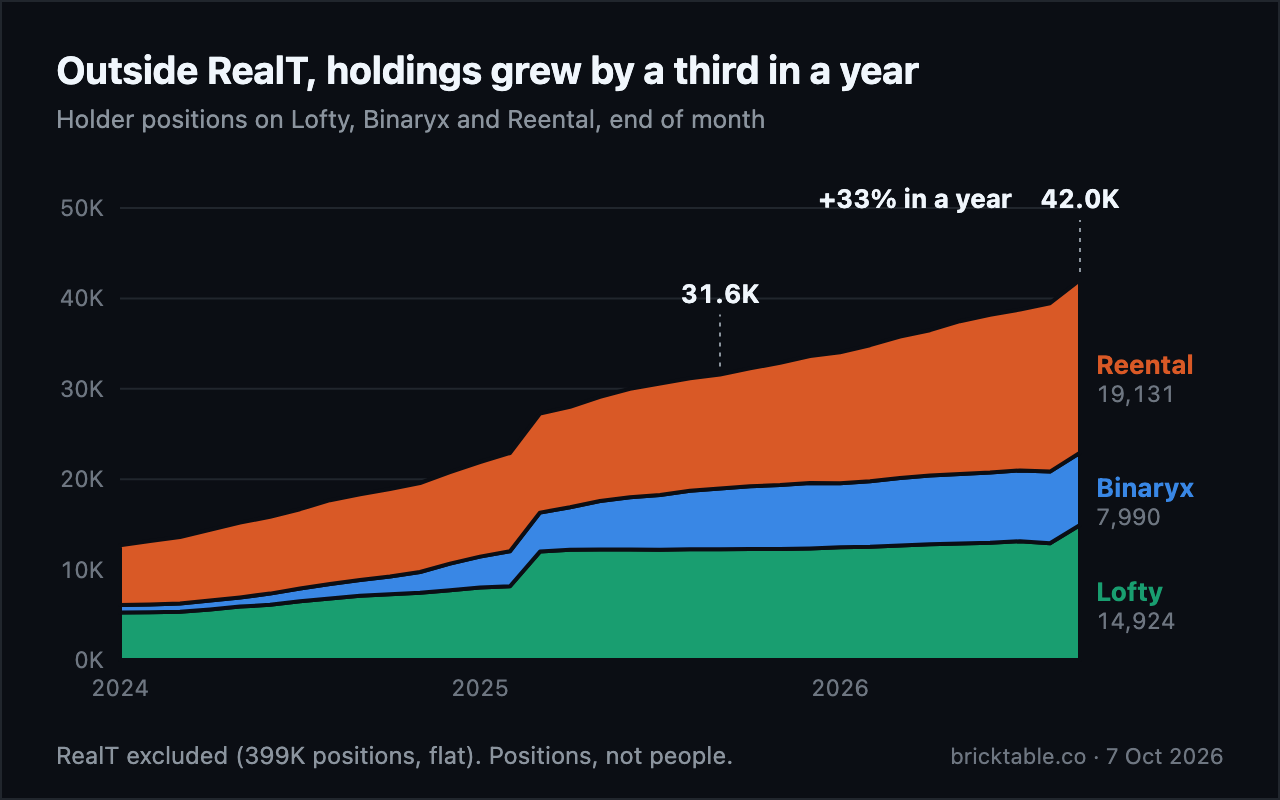
And it isn't slowing down. Those three platforms added 13.3% in the six months to March 2026 and 17.5% in the six months after — the same stretch in which search interest was rolling over.
Lofty is the clearest example. Its holder positions rose 15% in a single quarter, July through September, while US searches for the category were falling hardest.
Reental is the fastest grower overall, up more than half in a year. It is a Spanish platform, it issues mostly in euros, and it comes from the part of the world where search interest has held up best. Counting distinct wallets rather than positions, Reental still added 6.4% in just the last two months.
People stopped Googling the idea. The people already in it kept buying.
The part that should worry you
There is one number moving the wrong way, and it isn't demand. It's supply.
New listings across the four platforms, by half-year:
| Half-year | New listings |
|---|---|
| H1 2025 | 136 |
| H2 2025 | 37 |
| H1 2026 | 22 |
| H2 2026 (to date) | 8 |
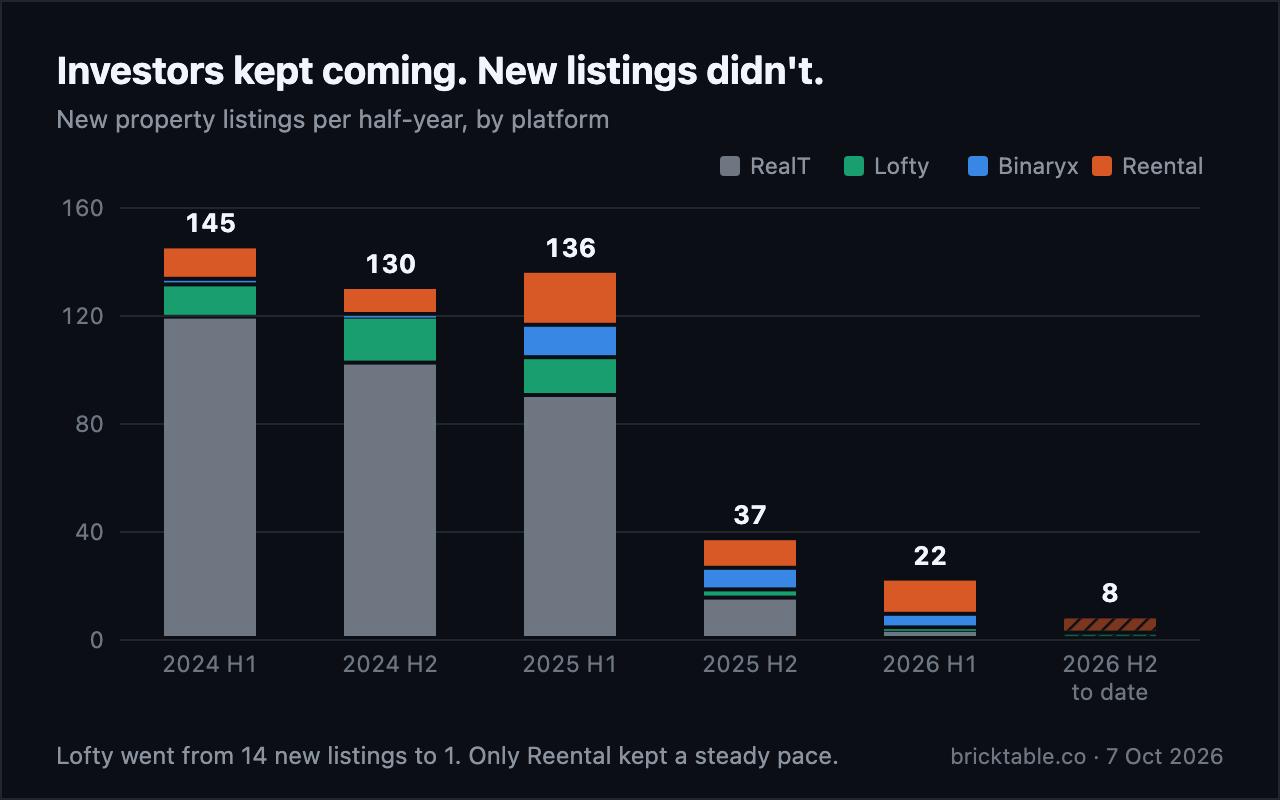
RealT stopping explains much of the first drop — it went from 90 new properties to 15, then 3, then none. But it isn't the only one. Lofty went from 14 new listings in the first half of 2025 to one in the first half of 2026. Binaryx went from 12 to 5. Only Reental has kept a steady pace, at roughly ten to twenty a half-year.
And the timing matters. Lofty and Binaryx slowed down in the second half of 2025, when search interest was at its height. Whatever made them list less, it wasn't a lack of curious buyers.
So this market now has more investors every quarter and fewer new properties for them to buy. For anyone holding a token, that has two consequences. Secondary markets matter more, because that's increasingly where the next purchase comes from. And knowing which of your properties are still paying — and which can still be sold — matters more than finding the next listing.
What it adds up to
Hype cycles have a familiar shape: a spike of attention, a plateau, a fall. Tokenized real estate is on the falling side of that curve.
But underneath the attention, a smaller and steadier market is doing something different. Outside one collapsing platform, the number of people holding tokenized property grew by a third in a year, and the growth sped up as the searches faded. The center of gravity has moved from the US toward Spain and the rest of Europe. The bottleneck is no longer interest. It's inventory.
That is a less exciting story than a boom. It's probably a healthier one.
How we measured this
- Holder positions are summed per listing: one wallet holding ten properties counts ten times. They measure how many holdings exist, not how many people. Distinct-wallet counts, which we have only from August 2026, are quoted where noted. Across Lofty, Reental and Binaryx there are about 11,600 distinct wallets today.
- Holder figures come from each token's on-chain transfer history, replayed daily.
- New listings are counted by each property's offering date.
- Search figures are Google Trends relative interest (0–100), worldwide and US, five years to early October 2026. They show direction, not volume, and small numbers round to zero.
- Data as of 6 October 2026. Live figures for every listing are on BrickTable.